Асоціація • А також • Члени
Ukraine Reconstruction Market Brief - October
Russia’s ongoing war continues to place Ukrainian businesses under considerable pressure. Security risks, labour shortages and operational disruptions remain major challenges. Yet projects are moving forward, new funding mechanisms are being introduced, and fresh opportunities are emerging. Understanding these developments, identifying potential areas for cooperation and keeping track of available support mechanisms: this is precisely the purpose of this new edition of Ukraine Reconstruction Market Brief.
In our “Business Opportunities” section, we highlight a new European funding programme supporting innovation in clean energy supply chains, as well as a public-private partnership (PPP) tender for the construction of a new surgical facility in Lviv.
How can French companies get involved in reconstruction projects financed by European institutions? In our Quick Interview, Matteo Rivellini, Head of the Ukraine Investment Team at the European Investment Bank (EIB), provides practical insights. He explains how companies can participate in internationally funded tenders and benefit from new European guarantee mechanisms designed to mitigate investment risks.
Public-private partnerships are also the focus of our “Green Recovery: Expert Insights” section. Yevhen Kalinin, Managing Director of Veolia Ukraine, discusses the obstacles that have hindered PPP development in the past, recent changes to the regulatory framework, and the conditions needed to attract more private investment into Ukraine’s infrastructure.
In “Reconstruction News”, we review the latest economic and regulatory developments, including growing security and labour-related pressures on businesses, new international funding for more resilient energy infrastructure, and the expansion of war-risk insurance coverage. We also examine regulatory changes directly affecting companies, particularly employee reservation rules and the implementation of ESG requirements.
Finally, we look back at two recent CCIFU events: our conference on the challenges of Ukraine’s post-war transition, which opened discussions on the transformations businesses need to anticipate today, and our webinar on corporate security, which explored practical solutions for maintaining business operations in an constantly evolving security environment.
Enjoy the read!
BUSINESS OPPORTUNITIES |
1. OPEN FUNDING
RENEW-BOOSTER Eurocluster: grants for clean energy supply chain innovation
RENEW-BOOSTER, co-funded by the EU Single Market Programme, provides fast, small-scale grants to SMEs developing innovations that make Europe’s clean energy supply chains more resilient. Projects should:
- Reduce dependency on critical raw materials and supply chain vulnerabilities
- Accelerate the green and digital transition
- Support the objectives of the Net-Zero Industry Act (NZIA) and the Critical Raw Materials Act (CRMA)
Eligible sectors (TRL 6-7, with tangible results in a short timeframe):
- Offshore wind, particularly floating offshore wind
- Photovoltaics
- Energy networks
- Cross-sectoral digital innovation applied to these sectors (AI, digital twins, energy management systems)
Deadline: 30 November 2026 at 17:00 CET
Two funding strands
| Strand A: Challenge-driven | Strand B: Open call |
| Logic | Supports SMEs responding to specific “challenges” defined by relevant energy or industrial leaders. | Supports SMEs applying through a single-stage open call mechanism. |
| Funding | Step 1: €10,000 for each of 3 selected SMEs per challenge, with at least 20% private co-funding (about 3 weeks, TRL 6-7). Step 2: one SME per challenge receives €50,000, with at least 40% co-funding (12 weeks, TRL 8-9) | Up to €10,000, €30,000 or €60,000 depending on project maturity, with private co-funding scaling by tier |
Key eligibility criteria
- The applicant must meet the EU SME definition.
- The applicant must be established in the EU-27 or a country participating in the Single Market Programme.
- Each SME may submit one application per strand. The cumulative maximum per SME across all RENEW-BOOSTER calls is €60,000.
- Co-funding must be the SME’s own financial contribution. In-kind contributions and staff time do not count.
Timeline: results in mid-January 2027, contract signature at the end of January 2027.
Source: European cluster collaboration platform, Diia.Business
Lviv launches PPP tender for a new surgical facility
The Lviv City Council has announced a tender to select a private partner for the construction, commissioning and subsequent maintenance of a new surgical facility under a public-private partnership (PPP).
Project overview
The selected private partner will be responsible for financing and procuring the construction and commissioning of the new surgical facility, as well as ensuring its maintenance once operational. The project provides for availability payments funded from the city budget.
PPP Term: 17 years, comprising two years for the construction and commissioning of the Surgical Facility and 15 years for its maintenance.
Tender procedure and key deadline
The tender will follow a two-stage restricted procedure:
Stage 1 - Qualification: Candidates must demonstrate compliance with the technical and financial qualification criteria and their capacity to implement the project. At this stage, only pre-qualification applications (PQ Applications) may be submitted.
Stage 2 - Bidding: Qualified bidders will submit their technical and financial proposals. The tender commission will evaluate the proposals and select the winning bidder.
The deadline for submitting pre-qualification applications is 20 January 2027 at 18:00 Kyiv time.
Tender documentation
The Request for Qualification (RFQ), including detailed submission requirements and access procedures, is availablehere.
Contact
Andriy Pavliv, Head of the Investment and Projects Office, Department of Economic Development, Lviv City Council
Phone: +380 32 254 60 06
Email: ppp.lviv@lvivcity.gov.ua
Source: Lviv City Council
2. Act now
Association presentation: Move Ukraine
MoveUkraine is an officially registered Ukrainian charity. Founded in May 2022, it provides safe and dignified housing for displaced Ukrainians and rehabilitation centers for those in need. MoveUkraine has raised $4,968,865 which funded 22 buildings and 6 specialized centers, including a children's hospital and rehabilitation centers.
Mission: provide internally displaced Ukrainians (IDPs) with safe and dignified housing (collective centers and social apartments), as well as to promote integration with the help of various programs. In addition, the mission includes the creation of rehabilitation centers for veterans and people with disabilities.
Key figures (May 2022 – November 2025)
- $4.97M total funds raised
- 31 completed projects across 12 regions in Ukraine
- 17 MoUs signed with communities across 7 regions for social housing and rehabilitation infrastructure
- 1,271 IDPs housed across 22 completed housing projects (1 social apartment building in progress)
- 9,150 rehabilitation patients treated across 5 completed centers (projected annual capacity: 31,660 across existing and 4 pipeline centers)
Why are we highlighting this initiative?
The reconstruction of Ukraine does not rely solely on large-scale infrastructure projects.
By highlighting organizations like MoveUkraine, the CCIFU aims to build bridges between humanitarian commitment and corporate mobilization. Partnering with this type of organization means taking concrete action today, while contributing to the overall effort of resilience and national reconstruction.
Contact: Mariana Dumenko, Project Assistant.
3. FLASH INTERVIEW
Matteo Rivellini,
Head of the Ukraine Investment Team at the European Investment Bank
“The opportunities are real and available now. Companies that start exploring these opportunities today, building partnerships and assessing potential projects, will be better positioned to contribute to Ukraine’s reconstruction and play a role in its future economic development”.
The EIB’s engagement in Ukraine
Ukraine remains one of the European Investment Bank (EIB) Group’s top priorities. Its work combines support for immediate resilience with long-term reconstruction and the country’s integration into the European Union.
Since the start of Russia’s full-scale invasion, EIB Group financing in support of Ukraine has exceeded €4.5 billion. Investments focus on energy, transport and connectivity, housing, municipal infrastructure and private-sector development.
The EIB is also strengthening its support for project preparation and implementation, helping Ukrainian authorities turn reconstruction priorities into concrete, well-prepared and deliverable investments.
What opportunities are available for French companies?
French companies can participate directly in international tenders launched under EIB-financed projects, subject to the eligibility and qualification requirements of each procurement procedure.
Opportunities include:
- Transport and connectivity: modernising railway infrastructure, connections with the European Union and border crossings;
- Energy: energy efficiency, renewable energy and integration with the European energy system;
- Municipal infrastructure.
An important point for French companies is that procurement procedures are launched by the Ukrainian beneficiaries of EIB financing—ministries, municipalities, public utilities or state-owned companies—not by the EIB itself.
How can companies access tenders?
Interested companies are encouraged to regularly monitor procurement notices published through:
→ Prozorro: Ukraine’s public procurement system;
→ The EIB’s project procurement website: procurement procedures related to EIB-financed projects;
→ EU procurement channels such as TED
For these larger international tenders, a French company can participate without necessarily having a Ukrainian entity or local partner. The specific conditions, however, are set out in each tender and need to be checked individually.
European guarantees: what instruments can help mitigate investment risks?
To facilitate European investment in Ukraine, the EIB is preparing to launch a €230 million EU Foreign Direct Investment and Single Market Integration programme, with support from the European Commission.
In cooperation with partners such as Bpifrance, the programme is expected to provide foreign direct investment guarantees, including political risk insurance, to support French companies investing in Ukraine.
Depending on the project, this support could be complemented by long-term financing and, on a selective basis, investment grants.
What should companies do now?
French companies are encouraged to explore opportunities to participate in Ukraine’s reconstruction by engaging early with Ukrainian ministries, municipalities, state owned enterprises and private partners, particularly in energy, infrastructure, water, healthcare, agriculture, digital and demining.
They can also follow project pipelines being developed with the EIB and other international financial institutions, while drawing on the French institutional network to identify emerging opportunities.
Companies with a concrete project can contact the EIB Group directly to explore available support. For companies at an earlier stage, the EIB’s partner banks in Ukraine may be a useful first point of contact, thanks to their local market expertise.
EIB's project procurement website
👉 Read the full interview on the EIB’s role in Ukraine and the opportunities for French companies in the country’s reconstruction.
4. GREEN RECOVERY: AN EXPERT'S VIEW
Public-Private Partnership in Ukraine: Why 85% of Concluded Contracts Do Not Work and Whether the Country Is Ready for Private Investment Now
Yevhen Kalinin, CEO of Veolia Ukraine
Since the introduction of the public-private partnership (PPP) mechanism in Ukraine, 201 contracts have been concluded. However, as of 1 January 2026, only 19 were being implemented. Fewer than one in ten concluded PPP contracts has reached the implementation stage.
For a country that needs to restore water supply, wastewater treatment, energy, transport and municipal infrastructure, this question has not only legal but also economic significance.
PPP is not privatisation, but a different model of infrastructure management
Public-private partnership is a long-term cooperation between the state or a local community and a private company, involving shared financial, operational and other risks. Unlike ordinary public procurement, PPP gives the private partner long-term responsibility for infrastructure development, investment, operation and service quality.
Crucially, infrastructure can remain in public ownership. The private partner contributes financing, technology and operational expertise, while the state or community retains control over strategic assets and establishes service requirements.
Ukraine has had a legislative framework for such partnership for many years. However, the existence of a law does not mean that the country has created the conditions for its practical application.
Why this model works in other countries
Romania’s experience offers a particularly relevant example. In 2000, Bucharest awarded a 25-year concession for its water supply and wastewater infrastructure to Apa Nova Bucharest, part of the development history of the French group Veolia. The municipality retained ownership of the infrastructure, while the private operator assumed responsibility for operation, modernisation and investment.
The project results demonstrate the potential of such a model. According to international financial institutions, compliance of water with EU quality standards rose from 69% to 100%, and the level of consumer satisfaction from 46% to 75%. By 2010, the private operator had invested more than USD 250 million in the system.
This experience is important for Ukraine for several reasons:
- it shows that involving a private operator does not necessarily mean privatisation of strategic infrastructure;
- success also depends on the quality of project preparation, the financial model, clear risk allocation and the municipality’s ability to monitor contract performance;
- the participation of international financial institutions makes it possible to structure projects in a way that is understandable and acceptable to international investors and lenders.
Therefore, Ukraine can use already proven European models, adapting them to its own conditions.
Why Ukraine failed to scale up PPP
Ukraine’s main problem has not been the absence of legislation, but the lack of institutional and financial capacity to put it into practice.
Several structural obstacles have limited the development of the market:
- Insufficient project preparation.
- Uneven distribution of risks between the state and the private partner.
- Limited institutional capacity.
- Unpredictability of the regulatory environment.
Is the situation changing now?
In 2025, Ukraine took an important step to relaunch the mechanism by adopting Law No. 4510-IX “On Public-Private Partnership”.
Main changes:
- created opportunities for combining private financing with state resources and support from international financial institutions
- improved the procedures for project preparation and the selection of private partners;
- opened the possibility of using mechanisms of state support, risk sharing and protection of investments from certain negative consequences of changes in legislation
In 2026, the government continued to develop the practical regulatory framework for the application of the new law. In particular, procedures for project preparation, analysis of their effectiveness and determination of the private partner were approved.
This is an important signal for international business: the state is gradually moving from general declarations about the need to attract private capital to the formation of procedures under which this capital can work.
What is needed to turn opportunities into investments?
To develop a functioning PPP market, Ukraine must now focus on four priorities:
- Creation of a portfolio of investment-ready projects.
- Predictable tariff regulation.
- Reliable guarantees of fulfilment of obligations by the public partner.
- Professional institutional capacity.
For Ukraine, public-private partnership can become one of the key tools for recovery. But its potential will be realised only when the state moves from the role of a works customer to the role of a full-fledged partner capable of sharing risks, ensuring the stability of the rules and being responsible for its own obligations.
RECONSTRUCTION NEWS |
5. Press review & key figures
Business under growing pressure: IER Monthly Enterprise Survey, September 2026
On October 13, the Institute for Economic Research and Policy Consulting (IER) published the September results of its New Monthly Enterprise Survey (467 enterprises across 21 of 27 regions, surveyed September 23–30). Business activity worsened for the second month in a row, and security risks have overtaken price growth among the main obstacles:
- -0.21 Business Activity Recovery Index (scale -1 to +1), down from -0.16 in August.
- 31.1% of firms report weaker activity than a year ago, up from 24.3%.
- 59% of businesses cite “unsafe to operate” as an obstacle, up from 48% in August. It moves from 3rd to 2nd place.
- 67% cite labour shortage, still the #1 obstacle (69% in August). Hiring difficulty keeps rising for both skilled staff (index 0.60, from 0.57) and unskilled staff (0.35, from 0.32).
- 47% cite rising input prices (50% in August), now 3rd. Even so, 58.3% of firms expect raw material prices to keep rising over the next 3–4 months.
Air raid alerts and attacks on logistics now carry a measurable cost for business:
- 58.7% of enterprises report lost working time due to air raid alerts. The average loss is 7.4% of working time.
- 49.5% have had to suspend production capacity, and 33.6% have cut output or services.
- 28% of enterprises had to halt work temporarily because of power outages in August. Those affected lost about 4% of working time.
On financing the recovery of affected businesses, companies look first to external sources:
- 51.6% expect compensation from Russia, and 51.2% from international financial aid.
- 69.4% oppose tax increases, even if state support is smaller. Only 8.6% support them.
Source: Institute for Economic Research and Policy Consulting (IER)
- CIF approves $116M plan to support resilient energy in Ukraine
https://www.cif.org/news/cif-endorses-116-million-plan-support-resilient-energy-ukraine
The governing board of the Climate Investment Funds (CIF) has endorsed an investment plan presented by Ukraine as part of CIF’s Renewable Energy Integration (REI) program for $116.2 million. The initial allocation is set to be $70 million, with modular expansion of $46.2 million, mobilizing an expected $693.8 million from the World Bank Group (including IFC), EBRD, and other sources including the private sector. The plan is designed to support resilient energy in war-affected Ukraine through a cross-border interconnector, renewables, and energy storage.
Source: CIF
- EBRD, EU and Aon expand war risk insurance facility to meet evolving needs of Ukrainian businesses
The European Bank for Reconstruction and Development (EBRD) is expanding the scope and capacity of the Ukraine Recovery and Reconstruction Guarantee Facility (URGF), its war-risk insurance scheme developed with Aon, a leading global professional services firm. The Bank is increasing the scheme to €150 million so that more companies in Ukraine can take out war-risk insurance and address the ongoing challenges posed by the war. The additional capacity is backed by donor coverage from the European Union under its Ukraine Investment Framework.
The facility’s scope has also expanded. The transport and storage of gas-related assets, as well as goods in temporary storage in warehouses will now be eligible for coverage, in addition to inland cargo, motor vehicle damage and railway rolling stock, which the scheme already covers.
Source: EBRD
- Reservation of employees: what changed for critical enterprises
On October 23, the Cabinet of Ministers amended the rules for designating critically important enterprises and reserving (exempting from mobilisation) military-liable employees. The Ministry of Economy and Environment has clarified what this means in practice.
Key point: existing statuses are not automatically lost. Enterprises that obtained critical status under criteria that remain unchanged keep it.
What is new:
- Central authorities and regional military administrations must review their criteria within ten days of the changes entering into force.
- The humanitarian sector is explicitly included. Organisations whose continuous operation is critical for the state in the special period can obtain the status.
- A new Coordination Centre for Reservation has been created. It reviews requests from state bodies, approves updated criteria, advises on which enterprises qualify, and approves reservation above 50% of staff.
Source: Ministry of Economy and Environment of Ukraine
THE CCIFU AS A PLATFORM |
6. Conference “Ukraine After the War: Anticipating the Challenges Ahead”
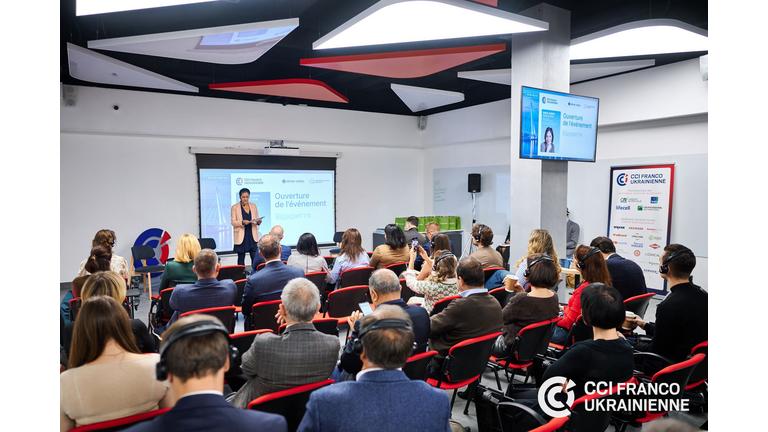
On 29 October, the CCI France Ukraine brought together experts, business leaders and company representatives to discuss the transformations Ukraine will face and the role businesses can play in preparing for the post-war period during the conference “Ukraine After the War: Anticipating the Challenges Ahead”.
The return of Ukrainians from abroad, the reintegration of veterans, changes in the labour market, evolving employee expectations and cooperation between Ukrainian teams and international headquarters are among the key challenges that companies need to anticipate today.
Three panel discussions provided an opportunity to explore these issues in depth:
Where are we today?
An overview of the current state of Ukrainian society, employees' psychological well-being, Ukrainian refugees' intentions to return, and the level of trust in businesses.
Watch speech of Keynote Dariia Marchak
Panel 1 Analysis of the current situation: what stage are we actually at?
What changes should we prepare for?
The transition of mobilised personnel back to civilian life, veterans' reintegration and how businesses can adapt to the new realities.
Panel 2 A looming turning point: what nobody is anticipating
What can we learn from history?
International experience and lessons that can help identify effective practices, avoid common mistakes and develop approaches tailored to Ukraine's specific context.
Panel 3 What history teaches us
One of the most moving moments of the conference was the contribution of Sofiia Rudneva, who shared the perspective of Ukraine's younger generation on the country's future.
Conclusion: practical recommendations
Testimonial from Sofiia Rudneva
The key takeaway from the discussions was clear: preparation for the post-war period must start today. Preserving and creating jobs, supporting veterans, addressing the psychological impact of war and helping organisations adapt to a changing environment will be among the key priorities for Ukraine's recovery and long-term development.
7. Webinar “Ukraine’s Security Reality: War, Technology and Business”
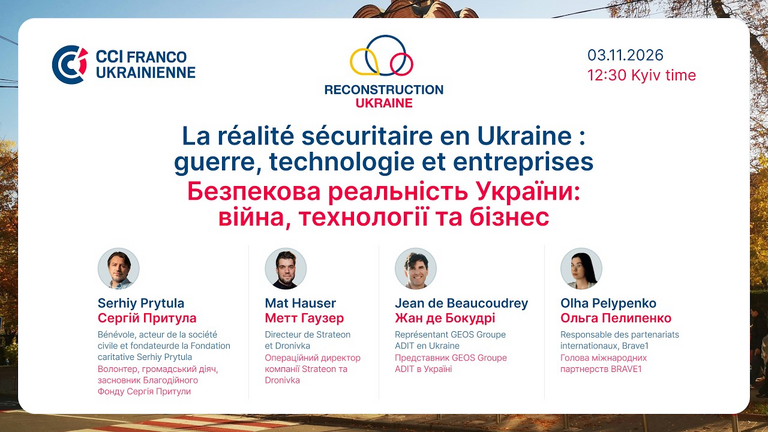
On 3 November, we hosted the webinar “Ukraine’s Security Reality: War, Technology and Business.” Four speakers shared their expert perspectives on one central question: how can businesses continue operating and remain resilient in wartime?
Serhiy Prytula (Serhiy Prytula Charity Foundation) discussed the evolving nature of aerial threats, the role of interceptor drones, and the contribution of civil society and the private sector to strengthening Ukraine’s defence.
His message to international businesses particularly resonated with participants:
“Ukraine’s Armed Forces protect not only Ukrainian businesses, but all companies operating in Ukraine. Supporting the procurement of modern interceptor drones also means protecting your businesses, your employees and human lives.”
Olha Pelypenko (Brave1) presented Ukraine’s defence innovation ecosystem and opportunities for international cooperation. Programmes such as Testing in Ukraine, Brave EU, Brave NATO and Brave France pave the way for technology testing, joint solution development and industrial partnerships.
Mat M. Hauser (Strateon and Dronivka) demonstrated how analysing more than 90,000 recorded strike-related incidents since 2022 can help assess the risks facing specific regions and facilities. While data analysis cannot predict every attack, it can help businesses better anticipate threats and prepare accordingly.
Jean de Beaucoudrey (GEOS Group ADIT) focused on the operational aspects of security, including crisis management, backup power and communication solutions, team preparedness and regular crisis simulation exercises.
Three key takeaways from the webinar:
1️⃣ Security must be an integral part of every company's business strategy.
2️⃣ Data and technology cannot eliminate risks, but they enable better-informed decisions.
3️⃣ For French companies, Ukraine's experience offers valuable opportunities for technological and industrial cooperation.
8. WHY JOIN THE CCIFU
Joining the French-Ukrainian Chamber of Commerce means establishing yourself in Ukraine with a trusted local partner at the heart of a dynamic network of nearly 130 French and international companies already active in the market.
In a rapidly transforming environment, the CCIFU supports you in securing your approach, accelerating your development, and connecting you with the right contacts at the right time.
Each year, the Chamber organizes nearly 60 events: sectoral meetings, conferences, professional committees, and networking events. These are concrete opportunities to understand the market, share feedback, and develop business opportunities.
Concrete benefits for members:
✓ One day of Business Support Services offered to every new member
✓ Access to high-level meetings in a small-group format
✓ Integration into an active network of French companies already established (direct contacts, partnership opportunities, field reports)
✓ Preferential rates on the Let's Rebuild Ukraine study
✓ Preferential rates with our partners (particularly in the hotel industry)
✓ Participation in sectoral committees (HR, agriculture, businesswomen, etc.)
✓ Increased visibility via our communication channels and events
Why now?
The reconstruction of Ukraine is already underway. It is being structured, financed, and organized today.
The companies present now will be the ones that understand the market, build key relationships, and seize the most strategic opportunities.
Do not let this window of opportunity close.
UKRAINE: PRACTICAL TIPS |
9. TRAVEL ADVICE
The security situation in Ukraine remains challenging but managed. It is crucial to understand that Russian strikes can occur across the entire country. We strongly recommend that you do not ignore air raid sirens and stay informed through official government channels.
Tip: To track alerts, manage power outage schedules, or locate the nearest shelter, download the Kyiv Digital app. It is available in English and allows you to register with an international phone number.
Useful WhatsApp groups: UA Air Force, SPRAVDI, Ukraine.ua, Suspilne
French nationals can enter Ukraine without a visa for stays of up to 90 days.
Transport
With airspace closed since February 2022, the simplest option is to fly to a neighboring country and then reach the capital by train (from Chelm, Warsaw, or another city). Please note: demand for these trips is very high.
For train ticket reservations, it is strongly advised to book in advance:
● In Poland: The PKP Intercity app is the go-to for long-distance travel. For regional connections or to compare bus and train options, the KOLEO app is also very efficient and intuitive.
● In Ukraine: For specific journeys between Poland and Ukraine, use the official app of the Ukrainian railway company, Ukrzaliznytsia (available in English).
Taxi services in Ukraine
Urban transport apps work very well in major Ukrainian cities.
● Bolt: Very widespread; it is often the fastest option with many available drivers.
● Uklon: A reliable local Ukrainian app.
● Uber: Also available in major cities like Kyiv or Lviv, though the fleet is sometimes less dense than Bolt's.
Daily life and restrictions
● Curfew: A curfew is in effect throughout the country. In Kyiv, it runs from 01:00 to 05:00. During this interval, it is strictly forbidden to be on the street without a special permit.
● Energy: Depending on the evolution of the situation, power outages are possible.
We recommend that you always carry your identity documents with you.
Business travel and insurance
For any business trip, it is mandatory to take out insurance that includes war risks. To determine which type of coverage meets your needs, we invite you to watch our dedicated webinar on this subject.
To define the insurance policy that is right for you, you can contact:
● GEODESK
● ATLAS RISK COVER
You can find a company to assist you with security-related matters among our members:
You can also watch the replay of the webinar dedicated to security.
10. BUSINESS CORNER - Legal advice
Simplifying medicine import (CMU Resolution No. 1254)
The Government has significantly reduced administrative barriers for suppliers. In particular, for drugs manufactured in the EU, USA, Great Britain, and other recognized countries, the mandatory requirement for a Ukrainian certificate of manufacturing compliance has been abolished, conclusions are now issued based on foreign certificates.
Additionally, the resolution introduces self-conducted remote visual inspection of cargo by companies, 1-day express control for re-imported batches, extraterritorial submission of documents to state control authorities, and reduced overall state control timelines to 5 working days (and 3 days for public healthcare procurements).
New procedure for selecting private partners (CMU Resolution No. 1204)
The Government has approved a new procedure for public-private partnership (PPP) and large concession projects (with public support exceeding EUR 5,538,000). It replaces the single-stage contest with three competitive procedures: restricted bidding, open bidding, and competitive dialogue, and introduces preliminary market consultations.
To streamline participation, the regulation simplifies qualification by allowing the European Single Procurement Document (ESPD) and validating qualification results for up to two years. Winners are determined by the most economically advantageous offer, while post-selection negotiations are strictly limited to editorial amendments without altering core contract terms or risk allocation.
Roadmap for ESG Principles Implementation (CMU Order No. 993-r)
On September 30, 2026, the Cabinet of Ministers of Ukraine approved the Roadmap for Implementing Environmental, Social, and Governance (ESG)Principles and Sustainable Finance Tools, along with an action plan for 2026–2028.
The plan comprises 11 tasks and 36 measures grouped into 5 objectives. It establishes timelines for drafting laws on sustainable activities taxonomy and corporate due diligence, introducing ESG requirements for banks, insurers, and capital market participants, as well as regulating green bonds.
Source: Arzinger